
Workshops
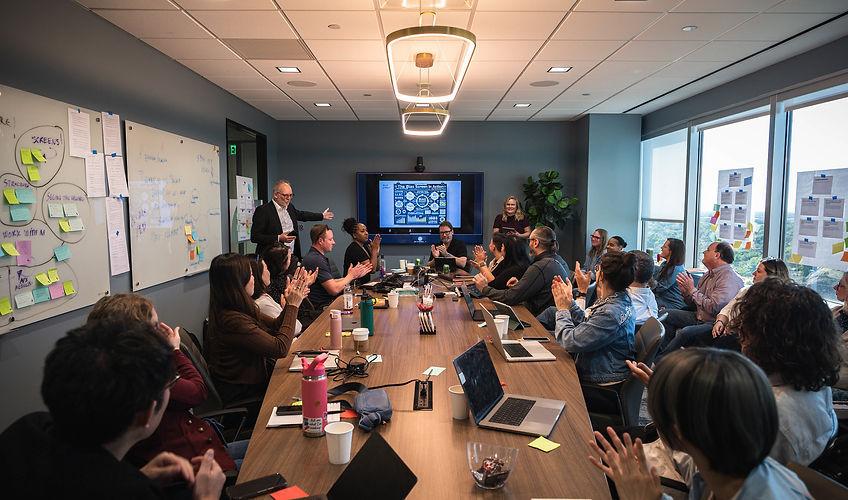
Our workshops bring together practitioners and thought leaders to create spaces for learning, experimenting, and connecting. Whether you’re looking to sharpen skills, explore new tools, or collaborate with peers, each session offers a chance to dive deeper into service design and co-create with a global community.
Workshops during SDGC26 will be held on Wednesday, October 28, 2026.
Morning (9:00 to 12:00)
Nextview Frankfurt Design Thinking Center (DTC)
Smaply 1 — From Maps to Management: Getting Started with Journey Management
Smaply
Journey maps only create value when someone is responsible for keeping them alive and connected to decisions. This workshop shows you exactly how to make that happen.
Target Audience: This workshop is for practitioners who are already comfortable creating journey maps but want to go further and build Journey Management as an ongoing organisational practice. That includes service designers, CX professionals, UX researchers, and product managers who work across teams and want a practical, repeatable system for keeping journey knowledge current and connected to real work. No prior experience with Journey Management tooling or governance structures is required; this workshop is the right starting point. It works well across industries, and is especially relevant for people working in mid-to-large organisations where maps are currently siloed, inconsistently maintained, or disconnected from delivery.
Morning (9:00 to 12:00)
Display room, Frankfurt am Main
Blueprinting Agentic AI Ecosystems
DesignThinkers
What happens to service design when the service is delivered by an ecosystem of AI agents? Learn how to blueprint the invisible systems, decisions, and interactions behind the next generation of services.
Target Audience: This workshop is designed for service designers, UX designers, developers, product owners, innovation professionals, strategists, and digital transformation leaders who are involved in designing or implementing AI-enabled services.
Morning (9:00 to 12:00)
Zukunftswerk, Wiesbaden
How to Conquer the Boundaries of Urban Development
Technologiestiftung Berlin / CityLAB Berlin
Step into the role of a Transformation Wizard in this scenario-based game where you’ll navigate the high-stakes trade-offs of urban innovation and public sector complexity. Master the art of balancing stakeholder trust and decisive action, then anchor your experience with a deep-dive debrief designed to master the "complex machinery" of real-world change.
Target Audience: Public Sector Innovators, Service Designer, Administration, everyone who is leading or guiding projects within the public sector landscape
Morning (9:00 to 12:00)
Nextview Frankfurt Design Thinking Center (DTC)
Stay Human: Training the Skills AI Can't Replace
Fail Fast Studio
65% of your current design skills will be irrelevant by 2030. This session tells you which 65%, and which ones become your biggest weapon. Bring your team's real weaknesses. You'll be solving them live, on the clock.
Target Audience: Service designers, CX leads, product design managers and design/strategy team leads (mid-to-senior level) who are actively navigating AI integration in their team or org. No prior AI knowledge required. What matters is having a real team (even a small one) in mind, since the exercise works best when scoring actual colleagues rather than a hypothetical. Particularly relevant for those who lead or influence hiring, upskilling, or tooling decisions for a design/CX team.
Morning (9:00 to 12:00)
German Design Council, Frankfurt am Main
Dear Future Citizen. Strategic Foresight in Designing Public Services
Deutsche Telekom AG
How can service designers help democratic institutions make decisions for people who are not yet represented in the room, including future citizens, both human, nature, animals and machines?
In this hands-on workshop, participants will combine Strategic Foresight and Service Design as methods to shape resilient and conscious government strategies and actions, designed for permanence. Participants will leave with a practical strategic foresight approach they can apply to service design, policy, strategy and transformation work, as well as a different way of thinking about responsibility in design: Are we designing only for today’s users, or are we helping shape the conditions in which tomorrow’s citizens will live?
Target audience: Service and strategic designers, researchers, strategists, innovators, policymakers, public-sector professionals, students and emerging practitioners, as well as anyone leading change, influencing it, or aspiring to shape change within their organization or community.
The workshop welcomes different levels of experience and is particularly relevant to people working on complex challenges where today’s decisions can have long-term consequences. No previous strategic foresight experience is required, just curiosity and a willingness to challenge assumptions, think beyond today’s users and needs, and take greater responsibility for the futures our decisions help create.
Afternoon (13:00-16:00)
Display Room, Frankfurt am Main
Simplifying the Maze: Crafting Clear Public Forms with Service Design
Innovation Office of the City of Cologne
Bureaucratic forms can be frustrating for citizens and employees alike. Find out why they are so complicated, how we simplify them in Cologne, and discover our approach.
Target Audience: Open to all levels, people who are interested in forms, UX-Writers
Afternoon (13:00-16:00)
Nextview Frankfurt Design Thinking Center (DTC)
Pardon our mess: Maintaining Alignment When Operations Can't Stop
Harmonic Design / Fraport
Transformation fails in the ripples between teams and systems that nobody is tracking. This workshop gives you the orchestration practice to catch them before they break.
Target Audience: Enterprise leaders, transformation agents, service designers, and innovation teams navigating complex systems that people depend on daily (across aviation, healthcare, finance, and tech).
Afternoon (13:00-16:00)
Nextview Frankfurt Design Thinking Center (DTC)
Smaply 2 — Journey Management at Scale: Governance, Use Cases, and Growing the Practice
Smaply
Most journey management practices stall not because of bad maps, but because of missing governance and unclear ownership. This workshop gives you the structure to make it stick.
Target Audience: This workshop is for practitioners, leads, and managers who have moved beyond the basics and are working to embed journey management as a sustained organisational capability. It suits people in roles such as CX leads, service design leads, journey coordinators, and design ops professionals, as well as managers and heads of department who are championing the practice internally and need to navigate governance, stakeholder buy-in, and scaling questions. A working familiarity with journey maps and at least some organisational experience with journey management is assumed. The content is industry-agnostic but particularly resonates in complex, multi-team or multi-channel environments where alignment across silos is a persistent challenge.
Afternoon (13:00-16:00)
PWC Experience Center, Frankfurt am Main
A Manifesto for Service Design for Robots
Lavrans Løvlie, Felix Scharf & Guests
The humanoids, quadrupeds, centaurs and spiders will soon emerge as the central touchpoints for service. They will meet us in retail stores, support us in health & care, clean our homes and entertain us. Therefore we need to establish design principles for robot behavioral design, for collaboration with customers, staff and citizens, as well as organizational change with robots.
Join us in moving beyond Asimov’s laws, and define the manifesto for the future of service design with robots
Target Audience: Service Designers, Business Innovators
Afternoon (13:00-16:00)
German Design Council, Frankfurt am Main
The Power of Conflict: Become a Better (Public) Designer by Navigating Conflicts Successfully
DigitalAgentur Brandenburg
Conflict is inevitable when creating meaningful change - but it doesn't have to stand in your way. Discover your conflict style and learn practical strategies to turn resistance and disagreement into opportunities for impact.
Target Audience: This workshop is for designers in both the public and private sectors. While the examples come from the public sector, the conflicts explored are relevant across organisational contexts. The public sector often amplifies challenges such as competing interests, multiple stakeholders, and resistance to change, making it a valuable environment for learning conflict-navigation skills that apply everywhere.
Afternoon (13:00-16:00)
Zukunftswerk at Luisenforum. Kirchgasse 6, 65185 Wiesbaden
When Service Meets Digital: Designing Better Public Services
Stadtlabor2Go: Zukunftswerk (CityLAB Wiesbaden), stadtlabor.mg (CityLAB Mönchengladbach). CityLAB Berlin
From testing to prototyping: Experience how better digital public services are created through collaboration, creativity, and user feedback. Join an interactive design sprint and help shape the future of digital government.
Target Audience: This workshop is aimed at professionals working in public administration, urban development, innovation, service design, and digital transformation, as well as anyone interested in creating user-centered digital services. No prior experience in design, UX, or technology is required. The format is particularly suitable for practitioners, project managers, designers, decision-makers, and innovation professionals who want to gain hands-on experience in developing and improving digital public services together with users. By bringing together participants from different backgrounds, the workshop fosters interdisciplinary collaboration and the co-creation of innovative solutions.
Afternoon (13:00-16:00)
Display Room, Frankfurt am Main
DRAW THE LINE - When good design means setting boundaries
nlmtd
Service designers are trained to create possibilities: remove barriers, reduce friction, connect systems and
design new solutions. But what if responsible design sometimes requires us to do the opposite?
In this interactive workshop, we explore boundaries not as obstacles to overcome, but as something we
can deliberately design. Where should a service stop? When should technology deliberately not intervene?
Which responsibilities should remain with people, organisations or algorithms? And which boundaries
might be necessary to protect autonomy, trust, human capabilities or public values?
Target Audience: Design practitioners who are interested in designing more inclusive and enabling experiences: from governmental services to commercial games.

Beyond Boundaries zeigt, wie Organisationen im öffentlichen und privaten Sektor in kollaborativen und interdisziplinären Herangehensweisen die heutigen Grenzen überwinden können. Service Design unterstützt sie dabei, eine resilientere und sinnvolle Zukunft zu gestalten.
Organisationen stehen branchenübergreifend vor strukturellen, kulturellen, technologischen und ökologischen Herausforderungen. Um diese zu meistern, reicht Expertise in einem einzelnen Feld nicht aus. Es braucht neue Formen der Zusammenarbeit – und ein gemeinsames Verständnis von Komplexität über Disziplinen hinweg.
Service Design spielt dabei eine zentrale Rolle. Es bringt Menschen zusammen, übersetzt Erkenntnisse in konkrete Maßnahmen und entwickelt Lösungen entlang realer Bedürfnisse. So hilft Service Design Organisationen, Übergänge aktiv zu gestalten und nachhaltige Veränderungen zu ermöglichen.
Unter dem Motto „Beyond Boundaries: Enabling Solutions That Shape Tomorrow“ bringt SDGC26 Praktiker:innen, Führungskräfte, Pädagog:innen und Change-Maker:innen zusammen. Zum Austausch darüber, wie Lösungen entwickelt, umgesetzt und skaliert werden – und wie so „Atmospheres for a Better Life” entstehen.

